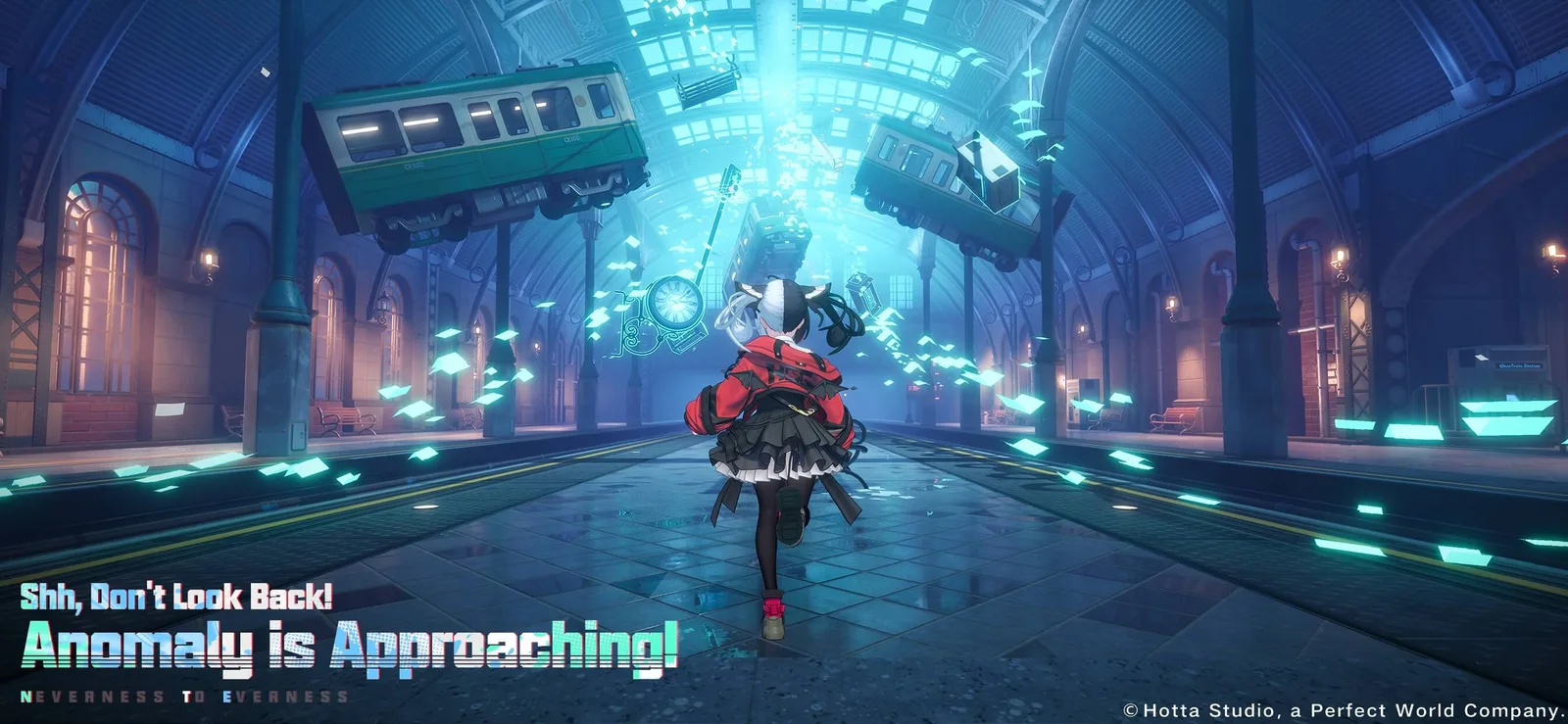
From the Tower of Fantasy Team, on a Bigger Canvas
Hotta Studio didn't come out of nowhere for this one. The same team built Tower of Fantasy, and after spending real production time on that game's most city-dense region (Mirroria), they used what they learned there as the starting point for something new rather than a sequel. Neverness to Everness launched worldwide on April 29, 2026, built on Unreal Engine 5 (a jump up from Tower of Fantasy's UE4 base) with DLSS and RTX support baked in — the studio's first game actually built around current hardware instead of scaling down for it.
The pitch: you're an unlicensed "anomaly hunter" in Hethereau, a city where supernatural Anomalies are a fact of daily life, and the job is equal parts investigation, combat, and just living in the place. It's a stranger, more grounded premise than Tower of Fantasy's sci-fi setting, and it mostly earns that shift.
What Hethereau Actually Feels Like to Play
Official character trailer — Enter Hethereau →
The reason this holds up past the first few hours is that Hethereau doesn't feel like one open world stretched thin — each district has a distinct visual identity and its own reason to explore it, which is the detail most gacha open-world RPGs skip in favor of one big generic map. Combined with companion recruitment (the game's gacha layer), a genuinely deep housing system, and city-management mechanics layered on top of the usual exploration-and-combat loop, there's enough going on that boredom sets in later here than in most games built the same way.
The free-to-play economy deserves a specific callout: it's unusually generous for the genre. Players who don't spend a cent still see real progress on companions and gear, not the token drip that makes most gacha RPGs feel adversarial toward anyone not paying. If your main hesitation about trying a game like this is the monetization model, Neverness to Everness is a better-than-average place to test the waters.
Six months post-launch, the numbers back this up without needing to take Hotta Studio's word for it: Steam reviews sit at "Very Positive," with 82% of over 2,700 total reviews positive, and 80% of recent reviews still landing the same way — a live-service game holding its reception steady rather than fading after launch hype wears off.
Where the Game Falls Short
The honest gap is combat. It's functional and looks the part, but it doesn't have the depth or the technical ceiling to compete with the genre's best — there's not much reward for mastering it beyond what a competent player figures out in the first hour. For a game you're expected to keep playing for dozens of hours, that's a real weakness, not a nitpick.
The story has the same problem in a different shape: version 1.0's pacing takes too long to get moving, and the companion cast introduced along the way hasn't left much of an impression yet. In a game structured around collecting and growing attached to those companions, forgettable characters undercut a system the whole game leans on.
Who This Is Actually For
If what you want out of an open-world RPG is a world worth getting lost in — distinct districts, a housing system worth investing in, city management that isn't just decoration — Neverness to Everness delivers that more convincingly than most games in its genre right now. If what you're actually looking for is a combat system with real depth to master, this isn't it, and no amount of exploring Hethereau's better districts changes that.
It's cross-platform (PC, PS5, Mac, Android, iOS), free to start, and the generous economy means you can reasonably judge it for yourself over a weekend before deciding whether the long-term systems are worth your time. Grab the official client here if Hethereau sounds like your kind of open world.
The Verdict
7.3/10. Combat won't blow you away and the story takes a while to hook you, but Hethereau is one of the best-looking, most systems-dense open worlds in the genre right now — and since it's free to play, that's an easy one to find out for yourself.
NTE
Pros
- Hethereau's city districts are genuinely distinct and gorgeous, not the usual gacha-RPG copy-paste
- A wide spread of systems — exploration, housing, companion collection, city management — that don't feel like padding
- Free-to-play economy is unusually generous by genre standards, real progress without paying
- Runs on UE5 with DLSS/RTX support, so it actually uses newer hardware instead of running on last-gen assumptions
Cons
- Combat is functional but shallow next to genre leaders — button-mashing holds up fine, mastery doesn't reward much
- Story pacing drags for the first stretch before the plot actually goes anywhere
- The companion cast is forgettable so far, which matters more in a game built around collecting them
 News
NewsSteam Deck 2: Valve Says It's Close, One Issue Left
No release date yet — but Valve confirms Steam Deck 2 is real and 'getting there.' Here's the exact chip problem holding it back, and what to buy today instead.
 News
NewsROG Xbox Ally X20 Preorders Are Live: OLED Screen, $1,299.99, October 15 Launch
Preorders for the ROG Xbox Ally X20 opened August 25, bringing the first true OLED screen to ASUS's handheld lineup. Here's what actually changed, the price, and what to know before you commit.
 News
NewsNvidia Hikes RTX Prices Again: RTX 5090 Nears $4,700 in Third 2026 Increase
Nvidia has raised GeForce RTX prices for the third time this year, pushing the RTX 5090 close to $4,700 — more than double its launch price. Here's why it's happening, and why it barely changes anything if you're building on a sane budget.